The answer depends on one important structure: your rotator cuff. Understanding how the rotator cuff works makes it much easier to understand why there are two different types of shoulder replacements.
Table of Contents
- What Is an Anatomic Shoulder Replacement?
- What Is a Reverse Shoulder Replacement?
- Why Would Someone Need a Reverse Shoulder Replacement?
- Does a Reverse Shoulder Replacement Mean Something Is Worse?
- Which Operation Lasts Longer?
- Will I Have the Same Motion After Surgery?
- Can I Lift Weights After Shoulder Replacement?
- What Are the Risks?
- How Do You Decide Which Operation I Need?
- Anatomic vs. Reverse at a Glance
What Is an Anatomic Shoulder Replacement?
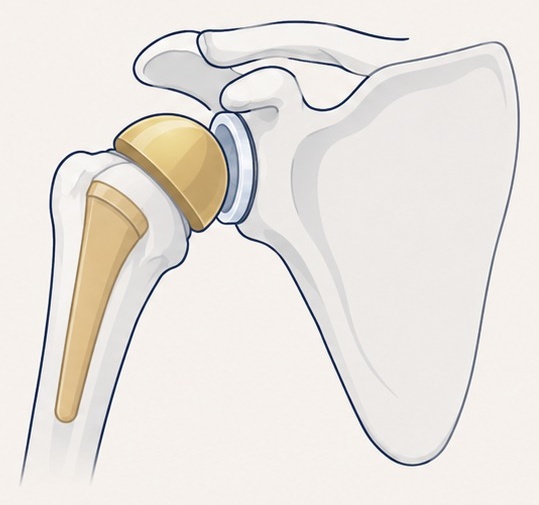
Think back to the golf ball analogy.
The golf ball represents the ball of your upper arm.
The tee represents the socket.
In an anatomic shoulder replacement, we simply replace the worn ball with a smooth metal ball and replace the worn socket with a new plastic socket.
Everything stays in its normal position.
This operation works extremely well when the rotator cuff is healthy because those tendons continue balancing the shoulder exactly as nature intended.
Anatomic means restoring normal anatomy.
What Is a Reverse Shoulder Replacement?
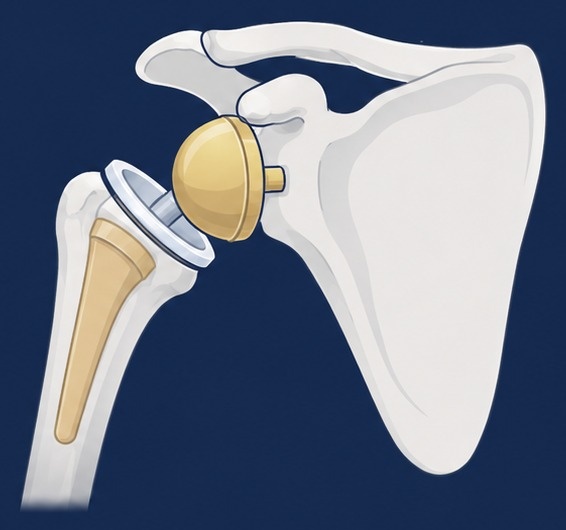
In a reverse shoulder replacement:
- The ball is attached to the shoulder blade
- The socket is attached to the upper arm bone
This completely changes the mechanics of the shoulder.
Instead of depending on a damaged rotator cuff, the operation allows the large deltoid muscle to lift the arm.
That is why reverse shoulder replacement has been one of the biggest advances in modern shoulder surgery.
Reverse doesn't simply reverse the implants. It changes how the shoulder works.
Why Would Someone Need a Reverse Shoulder Replacement?
A reverse shoulder replacement is commonly recommended for:
- Rotator cuff arthropathy
- Massive irreparable rotator cuff tears
- Complex shoulder fractures
- Certain revision shoulder replacements
- Some failed previous shoulder surgeries
If the rotator cuff cannot reliably stabilize the shoulder, an anatomic replacement often will not function well.
The reverse design solves that problem by allowing the deltoid muscle to become the primary elevator of the arm.
The operation matches the problem.
Does a Reverse Shoulder Replacement Mean Something Is Worse?
Many patients become worried when they hear the word "reverse."
They assume it means, "My shoulder must be terrible."
That isn't true.
Reverse shoulder replacement was specifically designed for shoulders that cannot be successfully treated with a traditional replacement.
In those situations it often produces outstanding pain relief and function.
The goal is not to perform the simpler operation.
The goal is to perform the correct operation.
Reverse isn't second best. It's the right operation for the right shoulder.
Which Operation Lasts Longer?
Modern shoulder replacements are expected to function well for many years.
Longevity depends on:
- Implant positioning
- Bone quality
- Activity level
- Overall health
- Surgical technique
For most patients, both operations provide many years of pain relief and improved function.
The best implant is the one that fits your shoulder.
Will I Have the Same Motion After Surgery?
Pain relief is the most predictable benefit of shoulder replacement.
Motion often improves dramatically.
However, the amount of motion depends on:
- Preoperative stiffness
- Rotator cuff function
- Muscle strength
- Bone quality
- Commitment to rehabilitation
The goal is functional motion.
Not perfect motion.
Less pain often allows better motion.
Can I Lift Weights After Shoulder Replacement?
Most patients return to:
- Light weight training
- Resistance bands
- Fitness activities
- Golf
- Swimming
- Gardening
Heavy repetitive overhead lifting should generally be avoided to maximize implant longevity.
Train for health — not for powerlifting.
What Are the Risks?
Potential risks include:
- Infection
- Stiffness
- Fracture
- Instability
- Nerve injury
- Implant loosening
- Persistent pain
- Need for future revision surgery
Fortunately, serious complications are uncommon.
Before surgery we'll discuss your individual risks and answer every question you have.
Understanding risks helps you make confident decisions.
How Do You Decide Which Operation I Need?
Choosing between anatomic and reverse shoulder replacement requires evaluating:
- Your X-rays
- Your MRI or CT scan when appropriate
- Your rotator cuff
- Bone quality
- Motion
- Age
- Goals
The operation is individualized.
There is no one-size-fits-all solution.
We don't choose implants first. We diagnose the shoulder first.
Anatomic vs. Reverse at a Glance
| Feature | Anatomic | Reverse |
|---|---|---|
| Rotator cuff required | Yes | No |
| Ball location | Humerus | Shoulder blade |
| Socket location | Shoulder blade | Humerus |
| Best for | Arthritis with healthy cuff | Rotator cuff arthropathy, massive cuff tears |
| Goal | Restore normal anatomy | Restore function when cuff is deficient |
Still Have Questions?
Every shoulder is different. If shoulder pain is limiting your life, schedule an appointment to discuss your symptoms and treatment options with Dr. Jadye Kee.